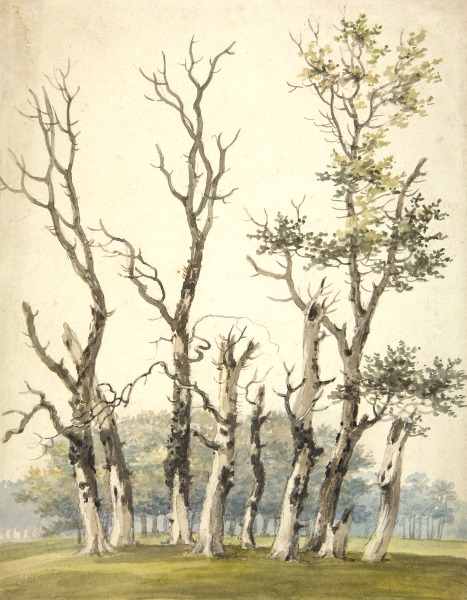
FDA-D.515-2010
Parts
Object number
FDA-D.515-2010
Object type
Identification
Title
A Stand of Dead and Dying Poplar Trees
Cornish Torbock
Title Type
assigned by cataloguer
collection
Comments
This drawing was formerly attributed to William Turner of Oxford (1789-1862), but it has every appearance of being the work of an earlier artist. It is suggested here that it may be by George Barret, but the attribution is open to question. The 'Stand of Trees' also resembles certain drawings by Joseph Barber (?1757-1811) of Birmingham, who, like many others, was influenced by Barret. It is hoped that by exhiting this little-known but beautiful watercolour at Dover Street, some new light may be shed on the problem of its identification.
Whether or not Barret is responsible for its execution, his work certainly forms a background to its production. Edward Dayes, who was generally critical of his contemporaries, wrote that 'Barret excelled in trees; but partcularly in his ash and beech, which are remarkably fine'. Barret, an Irishman, moved to London in 1762 and was a foundation member of the Royal Academy. He was one of the first London-based artists to draw what might be descirbed as portraits of trees, or of groups of trees. A watercolour by him of a leafless silver birch on the London art market in 1986 displays the same feeling for the structure of branches as is evident in the Eton watercolour (with Anthony Reed 1986, photograph Witt Library). A pencil drawing in the Witt collection at the Courtauld Institute, again of silver birch, features a centrally-placed tree, this time with foliage: it too is reminiscent of the Eton drawing (Witt collection 4280).
In the mid -1770s Barret painted panoramic Lakeland landscape on the walls of one of the principal rooms at Norbury Park for the well-known amateur and collector William Lock. A watercolour study for one of the painted walls was sold at Sotheby's on 16 July 1970 (lot 11); this too features graceful trees framing the lake view. It is perhaps interesting to note that Barret's Norbury wall-paintings seem to have influenced Paul Sandby's painted room at Drakelow Hall, Derbyshire, executed in the 1790s, which also features a lake view framed by trees.
Dead or dying trees might seem unpromising subjects but they were widely appreciated as picturesque objects by landscape artists and theorists of the eighteenth century. Decaying trees played a prominent role in the paints of the seventeenth century Dutch artist Jacob van Ruisdael (c.1628-1682), who was a major influence on the young Thomas Gainsborough. A careful drawing by Gainsborough of Ruisdael's 'La Foret' (featuring a dead birch tree) is now in the Whitworth Art Gallery, Manchester. Uvedale Price, whose theory of the Picturesque owes much to lessons learnt from Gainsborough, deliberately left dead branches and even whole skeletal trees in his famous woodlands at Foxley in Herefordshire.
Other number
CT 11
Description
Dimensions
height (actual size): 223mm
width (actual size): 172mm
Materials & techniques note
Pencil and watercolour
Production
Person
Barret, George, 1732 - 1784 (Attributed to)
History and association
Object history note
Provenance: Collection of Cornish Torbock; by whom bequeathed to Eton College
Previous ownership
Torbock, Cornish, 1905 - 1993: Bequeathed
References
• Ryan, H., Hidden Treasures, W.S. Fine Art exhibition catalogue, 2010 (No. 6, p. 22-23)